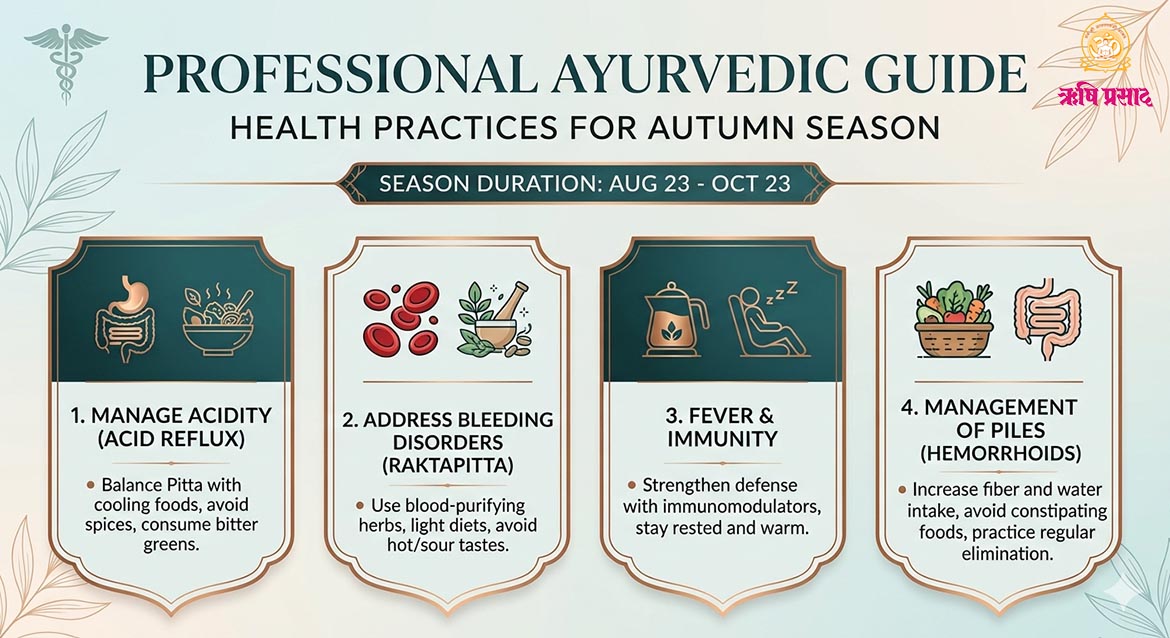
With the transition from one season to another, new ailments attack the body as the seasons change. The transition period between the rainy season (Varsha Ritu) and the autumn season (Sharad Ritu) gives rise to disease particularly caused by the aggravation of Pitta Dosha, such as Amlapitta (hyperacidity), Raktapitta (bleeding disorders), fever, and hemorrhoids (piles). At such a time, if proper attention is not paid to one’s diet (Aahaara) and recreation (vihaara), even the most efficacious medicine may prove ineffective.
(1) Amlapitta (Hyperacidity): During this season, excessive wandering in the sun or consumption of sour, spicy, and deep-fried food can cause problems, like headaches, vomiting, a burning sensation in the stomach or chest, dizziness, weakness, and irritability in the patients of chronic hyperacidity. The use of Aamla (Indian gooseberry), Avipattikara Churna, and Triphalaa Churna* is considered beneficial in such cases. The diet may include ghee*, green gram (mung beans), pointed gourd (parval), bottle gourd, ridge gourd, sponge gourd (gilki), pomegranate, and apples. Avoid heavy, spicy meals and restrain anger.
(2) Raktapitta (Bleeding Disorders): When Pitta Dosha is aggravated, it vitiates the Rakta DhÍtu (blood). As a result, the vitiated blood may be discharged through various openings, such as the nose, mouth, or rectum. This condition is known as Raktapitta. In such cases, it is essential to avoid consumption of excessively sour, salty, pungent, and foods hot in potency, as well as curd (yogurt), buttermilk, and fermented sour gruel (khatte khaare). One should also avoid prolonged exposure to the sun and excessive heat. The intake of cooling food, possessing sweet (madhura), bitter (tikta), and astringent (kasailya) tastes are recommended. Adusaa (Adhatoda vasica) is an excellent remedy for Raktapitta. Consuming the fresh juice extracted from 15–20 tender leaves of this plant two to three times daily is highly beneficial. If fresh leaves are unavailable, Adusaa Arka* (a distilled herbal preparation) may be used as an alternative. In addition, mixing equal parts of Shataavari*, Mulethi (Licorice)**, and Aamla powder* and taking one teaspoon of this mixture with water three times a day is also recommended. If bleeding from
the nose (epistaxis) occurs, sprinkle cool water over the head, and instill two drops of the fresh juice of Durvaa grass (Cynodon dactylon) into each nostril.
(3) Fever: During the junction of the rainy season and the autumn season, one is predisposed to Pitta-related as well as infectious fevers. Such conditions are particularly aggravated by consuming stale food, excessively fried and spicy dishes, curd (yogurt), and buttermilk, as well as by prolonged exposure to the sun, impaired digestion, etc. Therefore, avoid them and consume a light, easily digestible and wholesome diet. Among the Ayurvedic formulations, Mahaasudarsana Churna**, Sansamani Vati*, and Giloy (Tinospora cordifolia) are beneficial in the management and prevention of fever.
(4) Piles (Hemorrhoids): During this season, the aggravation of Pitta Dosha often leads to the worsening of piles. For this reason, a traditional Ayurvedic practice observed during NavarÍtri is to undertake a regulated dietary discipline, subsisting for the nine days primarily on elephant yam (amorphophallus campanulatus) sautéed in ghee, and fresh buttermilk. This regimen prevents and controls piles. Mix half or equal parts of water with fresh sweet yogurt and churn it with a wooden churner. Add roasted cumin powder to it before consumption. Take 2–3 grams of Triphalaa Churna at bedtime. If the hemorrhoids are painful, mix 2 drops of Amrit Drav* in 8-10 drops of ghee and apply it, or apply castor oil. If the piles are bleeding, burn the outer husk of a coconut to make ash. Whisk a bowl of freshly set yoghurt and dissolve one spoonful of this ash in it. Drink the mixture on an empty stomach in the morning. During this period, avoid chilies, pearl millet (baajaraa), fried food, and stale food, while taking care to prevent constipation. Consultation with a qualified Ayurvedic physician or healthcare practitioner is essential.
----------------------
* These may be obtained from Sat-saahitya Sewaa Kendras in the Sant Shri Asharamji ashrams and from Ashram e-store (download the “Ashram e-Store” app).
** Available at the Àrogya Kendras (Ayurvedic Health Centres) located at the ashrams.