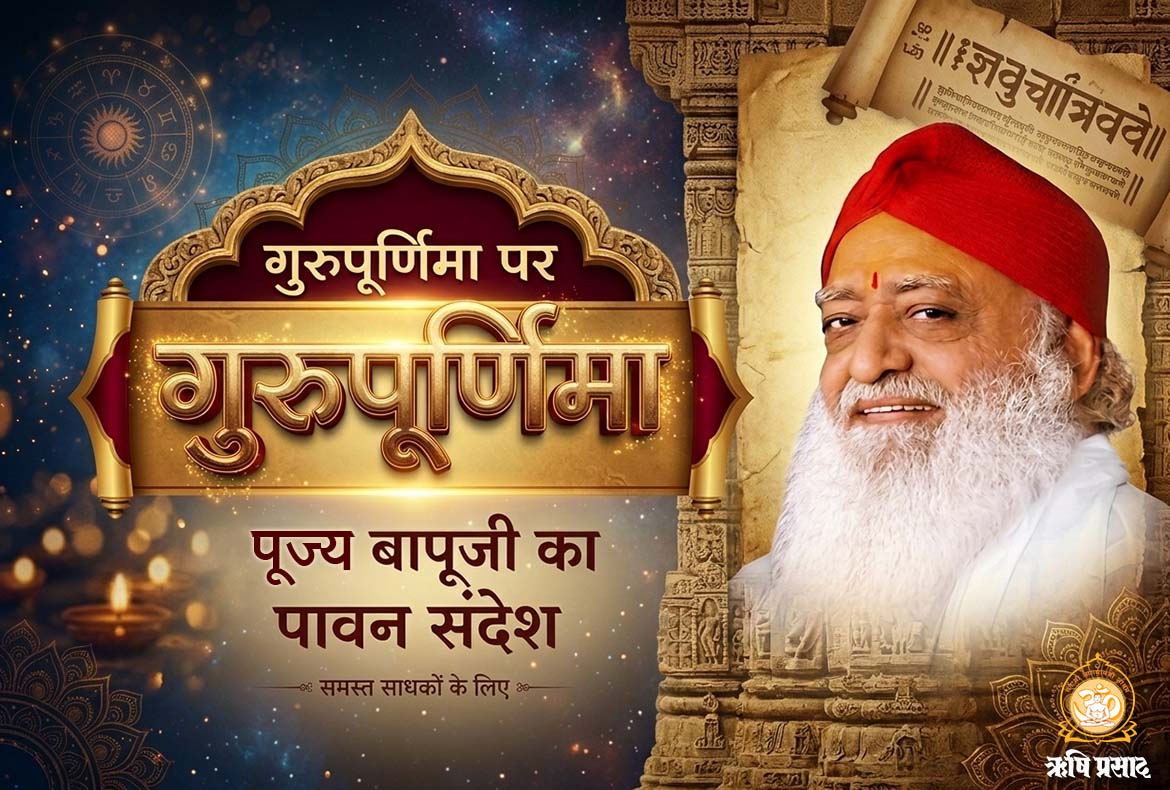
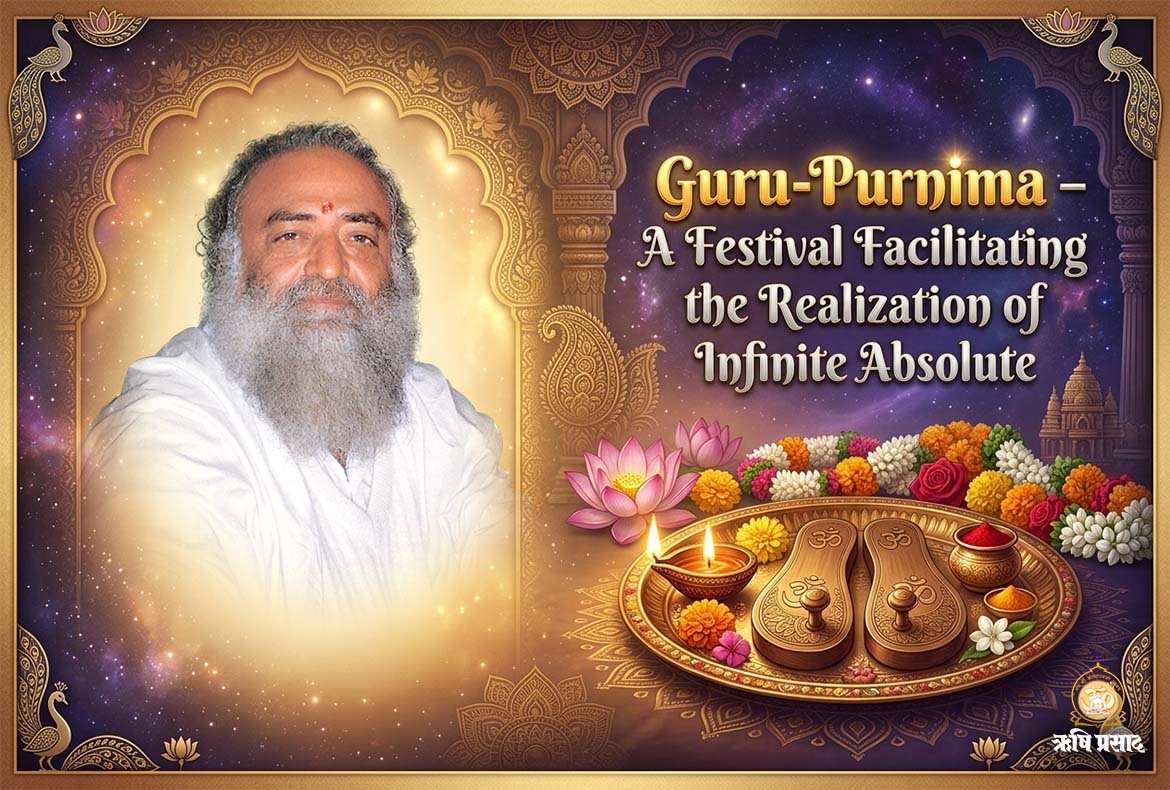
The 29th of July marks the grand festival of Guru-Purnima, one of the most significant festivals in Sanaatan Dharma. It is celebrated fervently across all branches of Sant Shri Asharamji Ashrams in India and abroad. From dawn, saadhakas begin gathering at the Ashrams. Expressing their heartfelt gratitude to their Gurudev Pujya Bapuji, who imparts jnaana (Self-knowledge) to them, on this day, devotees mentally worship Him. And the sequence of satsang-discourse sessions, divine name chanting, distribution of prasaada, etc. continues all day.
Pujya Bapuji, in His ambrosial satsang-discourses, often expounds the necessity and significance of this festival, as below:
The Jeeva (individual soul) is beginningless, and so is Ishvara (God), avidyaa (ignorance), the relation between avidyaa and pure consciousness, or even the difference between Jeeva and Ishvara, for that matter; yet none of the aforementioned are endless; it is only the Brahman that is both beginningless and endless (infinite). Upon realization of the knowledge of That beginningless and endless Brahman, all other entities – though beginningless – become saanta (terminable). Even the effect of these 5 entities come to an end but the pure jnaana (knowledge of Brahman, the Supreme Self), never ends. To keep the tradition of attaining such pure knowledge alive, the gods (devataas) glorified the day of Guru-Purnima by means of blessings. Saadhakas fully reap the benefit from this Purnima (full moon day).
The Purnima that facilitates the realization of such Infinite Absolute, where the effect of prakriti (primordial nature) and maayaa (illusion) come to an end, and so does the jivahood of Jeeva (individual soul) and the fear of Ishvara, and yet the jnaana or consciousness of Ishwara tattva never ends – is what is called Guru-Purnima.
In the word ‘Guru’, the syllable ‘Gu’ stands for darkness and ‘Ru’ for light. Thus, One, who removes the sanskaaras of ignorance, carried along in countless births, and illuminates their life with the light of the ‘Self’, the eternal light of Absolute knowledge is called ‘Guru’. Where even the sun’s light fades, and that of the moon fails to make it, how can the light from poor fire or even stars succeed? As implied by the following verse of the Gitaa:
न तद्भासयते सूर्यो न शशांको न पावकः ।
यद्गत्वा न निवर्तन्ते तद्धाम परमं मम ।। (गीता : 15.6)
“Neither the sun, the moon nor fire illumines That. That is my supreme Abode, reaching which they do not return.” (The Gitaa: 15.6)
ज्ञात्वा देवं मुच्यते सर्वपाशैः । (श्वेताश्वतर उपनिषद् : अध्याय 6, मंत्र 13)
“One is released from all fetters on realizing Him.” (Shvetaashvatara Upanishad: Chapter 6, Mantra 13)
Realizing that Self, one is forever released from all fetters. The festival that inspires one to attain such Self-knowledge, is called the festival of Guru-Purnima. One may perform all kinds of religious duties, rituals, and meritorious acts but without this jnaana, everything is incomplete. Jadabharata Ji said,
“O Rahoogana! Without bathing oneself in the dust of the feet of Self-realized saints (without truly imbibing the experiential words emanating from their hearts), one cannot attain God-realization. Not through austerity, Vedic rituals, offerings of food or water, Charitable acts, guest service, or even rigorous study of the Vedas – none of these alone lead to Paramaatma-jnaana.”
(Shreemad-Bhaagavatam: Canto 5, Chapter 12, Verse 12)
This jnaana can be attained only through Guru’s grace. Àdi Naaraayana realized it through Supreme Brahman (Existence-Consciousness-Bliss Absolute), and from the former, it was passed on to Rishis and Munis, who then bestowed this jnaana on to their disciples, and then on to their disciples…and so on… Thus, it is only through Guru-Paramparaa (the disciplic succession through which spiritual knowledge is transmitted by bona fide spiritual masters) that one can hope to realize the shuddha (free from the stain of ignorance), Buddha (self-luminous), eternal, Truth-nature Self (Supreme Self).
Even Then Gurus Will Continue to be Revered
Even if there is an attempt to defame Gurus by carrying out malicious propaganda against them, the Gurus will continue to be revered. When jnaana (Pure Consciousness) is neither born, nor subject to death – how can the influence of those great ones who have attained peace in the Self through aatma jnaana (Self-realization) ever die? Slanderers have persecuted and reviled all great men like Sant Naamadeva Ji, Sant Narsinh Mehta Ji, Sant Goraa Kumhaara Ji, Sant Kabir Ji, Guru Naanak Ji, Sant Jnaaneshvara Ji, Sant Tukaaraama Ji, Sant Eknaath Ji through smear campaigns. Even during Lord Raama’s rule, slanderers left no stone unturned to hurl slander at the revered Sage VasishÛha – a competent Spiritual Master (SatGuru). In the Yoga-VaasishÛha Mahaaraamaayana, VasishÛha Ji says: “I know what the ignorant say about me and how they mock me, yet because of my compassionate nature, I wish somehow, that they escape this hellish samsaara – that’s why I teach.
If you find a saint or saadhu who has even a single good quality, adopt and accept it and don’t dwell on their faults. O Raama ji, I humbly pray that you listen to my teachings with the deep faith that it will emancipate you.”
How great is the Giver of Knowledge, the Ocean of knowledge! Just as the ocean cannot contain itself in its limits upon seeing the full moon, even the Guru, upon seeing His perfect, true disciples, cannot contain Himself in His being. The ocean-like Guru casts out pearls of grace, and the hearts of disciples become moved and overwhelmed with emotion.
Guru-Purnima is the festival that gives the message of being whole and complete. It is a sacred vow. On this day disciples don’t eat before worshipping their Guru. The devotees (of the Guru) celebrating Guru-Purnima are blessed with jnaana, devotion, and religious merit.
Method to Make a Resolve and Perform Maanasa poojaa
On the night before Guru-Purnima, as you prepare to sleep, make a sacred resolution: ‘Tomorrow, morning, the moment I wake up, I shall reflect upon the jnaana imparted by my Guru and meditate on the Supreme Self manifested as the Guru, and offer mental worship (Maanasa poojaa) at His lotus feet.’ Then, while gently practicing ajapaa-japa (chantless mantra associated with the breath, repeating mentally ‘So’ with inhalation and ‘Hum’ with exhalation), pass into sleep. Upon waking in the early hours before sunrise, sit up in bed and assert: ‘Today is the sacred full moon – the day of Guru-Purnima that transforms the Jeeva (individual soul) into Shiva (Ishvara), that elevates the small or lowly into the great, and helps the individual soul wandering in the cycle of 8.4 million species attain the state of the Supreme Self. Today, I shall offer my Guru mental worship (maanasa poojaa) with deep reverence.’
Spend a few moments meeting your Guru mentally, and conversing with Him. The divine vibrations of your sankalpa (resolve) are especially powerful in amritvelaa (a sacred period that refers to the pre-dawn hours, starting around 3 a.m.) Then, after bathing and practicing Praanaayaama, etc., perform mental worship during your daily spiritual routine. Observance of maanasa-puja, mauna (silence), fasting, hearing satsang-discourses, and having darshan of the Guru brings special benefits on this day.
When I lived far away from my Guru (at His behest), hundreds of kilometres away, I would perform mental worship of my Guru as mentioned below: I would mentally bathe the Guru, dry His body with a towel, clothe Him, apply saffron-sandal tilaka, adorn Him with garlands of flowers and pearls, and then focusing my gaze on the Guru, reflect: ‘My Guru is Brahmaa, Vishnu, Mahesha – and the very embodiment of Consciousness. Though appearing confined to a body, He is all-pervading. The entire universe is a manifestation of the Guru, God, and Consciousness. My Guru is immanent in all beings. Om Shri Gurubhyo Namah!’ The Guru would not stop anyone from performing such worship. And it will lead you to the essential nature of the Guru, helping you realize the Guru-Tattva.
Then, after having performed maanasa-puja, I would converse mentally with my Gurudev ‘Saai! How are You? All well, I hope? Wah, wah, My Saai !!…’
On Guru-Purnima, I would do this, and on other days, I would walk, move, and live as if I were associated with Him. As a result, my other brother-disciples remained at their own state of being, while I was established in my real state of being by my Gurudev